
Industrial maintenance is the primary means of keeping an industrial building in good condition. It also helps to prevent problems arising during day-to-day operations, thereby enhancing industrial safety.
Proper industrial maintenance ensures that available material resources – such as equipment and machinery – are preserved until the end of their useful life, aided by the use of industrial safety equipment.
The correct maintenance of an industrial warehouse is based on planning and periodicity, if any of these aspects fail, the consequences will be serious for the industry.
What is an industrial maintenance plan?
An industrial maintenance plan consists of a series of activities and tasks in charge of increasing the useful lifespan of an industrial complex, treating every equipment and machine individually in order to reduce the number of failures and accidents.

The activities and tasks of an industrial maintenance plan, which are grouped and concatenated following a technical criteria, are assigned different periodicities, either daily, quarterly, annually, etc.
Why is it useful to have an industrial maintenance plan?
An industrial maintenance plan allows you to organise all improvement and conservation activities for a warehouse or logistics complex, which usually has an overwhelming number of tasks and activities.
Industrial maintenance plans will allow you to create a scheme that serves as a program and schedule for activities of a preventive nature.
In addition to extending an industrial warehouse’s lifespan, the maintenance plan seeks to increase its productivity, improving the availability and reliability of activities through scheduled shutdowns; that is, with minimal impact interruptions.
On the other hand, industrial maintenance plans provide a reduction in renovations and reform costs.
How often should an industrial warehouse be maintained?
The periodicity with which the maintenance of an industrial warehouse should be carried out isn’t something easy to define, it depends on several factors and on what needs to be maintained.

For example, the frequency of maintenance work on forklifts and other mechanical equipment depends on the manufacturer’s specifications.
Therefore, it’s advisable to take into account the manufacturers specifications when carrying out the industrial maintenance plan for the company’s existing machinery and equipment.
It’s is advisable to carry out further tests, in addition to the maintenance specifications for equipment and machine failures, if the company considers it convenient.
The main maintenance frequencies are usually carried out in the following manner:
- Daily frequency: equipment inspection and data collection activities carried out by operational staff.
- Monthly frequency: mechanical and technical maintenance of equipment prone to dirt and misalignment.
- Quarterly frequency: schedule for preventive and predictive maintenance, useful for electrical systems.
- Annual frequency: mechanical, electrical and instrument maintenance. Activities may be spread throughout the year or carried out on specific dates.
What happens when the correct maintenance isn’t carried out?
The immediate consequence of inadequate industrial maintenance is the deterioration of the material resources, which results in an extra economic cost.
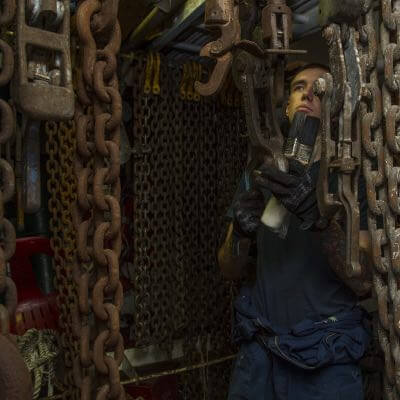
Inadequate maintenance forces a restructuring of the industrial maintenance plan, since additional actions will be required to eliminate the deterioration in the machinery and equipment affected.
In addition, if the deterioration of material resources already has an economic impact due to the cost of corrective actions that would have to be carried out, poor maintenance management can also lead to other types of problems in an industrial warehouse, which could force to stop production. This implies significant losses of time, resources and money for the company.
It must also be recognised that inadequate maintenance can affect workplace safety by increasing the risk of hazards and workplace accidents, thereby undermining workplace safety.