
Holes, damaged concrete and old repair patches that are breaking up can disrupt vehicle traffic and everyday operations in warehouses and factories. BECOSAN® UK Ltd provides concrete patch repair across the United Kingdom, removing unsound material and rebuilding affected areas with repair mortars selected for the floor’s condition and operational demands. We repair localised damage and replace failed patches, restoring a sound surface level with the surrounding floor.
BECOSAN® selects the repair mortar based on the depth of the repair, the condition of the substrate, the loads and the intensity of traffic. Where conditions require it, we use R4-class rapid-setting mortars, reinforced with corrosion-resistant metal fibres, which allow repairs to be carried out at depths of between 10 and 300 mm.
Work can be planned in sections, so that the rest of the building remains operational, and the depth and bond strength of each repair are checked before and after setting.
| Repair depth | 10–300 mm |
|---|---|
| Repair mortar | Class R4, CE-marked to EN 1504-3 |
| Strength | ≥2 MPa bond; up to 50 MPa at 28 days |
| Back to vehicle traffic | From 4–6 hours |
| Warranty | 2 years, written |
| Coverage | United Kingdom |
1-minute explainer
A small chip in an industrial concrete floor rarely stays small. Every time a forklift drives over the damaged area, it keeps losing material, and vibrations, uneven surfaces and dust begin to appear. The longer the repair is delayed, the larger the intervention becomes.
Damage like this is often the result of an earlier problem, such as a crack, repeated impacts or progressive deterioration of the concrete that was never properly repaired. The solution is a concrete patch repair: BECOSAN® does not pour a new slab. It removes all the deteriorated material until it reaches a sound, stable substrate and rebuilds only the affected area with a patch of mortar designed for industrial floors, restoring the continuity and strength of the surface. When the patch repair is part of a complete rehabilitation, it is integrated with the BECOSAN® treatment, which leaves a dust-free floor.
What happens when a small area of an industrial floor starts to break down? Stay with me and I'll explain it in one minute.
At first, it might look like nothing more than a small chip in the concrete. But as forklifts continue to drive over it, that damaged area keeps losing material. Vibrations, uneven surfaces and dust begin to appear, and the deterioration gets worse every day. And the longer the repair is delayed, the bigger the intervention eventually becomes.
What many people don't realise is that these damaged areas are often the result of an earlier problem: a crack, repeated impacts or progressive deterioration of the concrete that was never properly repaired.
At BECOSAN®, we don't pour a new concrete slab. Instead, we remove all the deteriorated material until we reach a sound and stable substrate. We then rebuild only the affected area using specific mortars designed for industrial floors, restoring the continuity and strength of the surface. It's not about hiding the damage. It's about restoring the functionality of the floor so it can continue to withstand industrial traffic safely.
And when this repair forms part of a complete rehabilitation, we integrate it with the BECOSAN® treatment, creating a stronger, dust-free floor. Because a repair carried out in time will always be simpler than an intervention once the damage has spread.
If your floor has damaged areas or localised concrete loss, contact the BECOSAN® technical team.
In-depth video guide to the full process
A faulty patch rarely remains the same size. What can be seen on the floor usually indicates a cause, and that cause determines how the repair is carried out. The following information links the most common signs to their usual causes and to the solution offered by BECOSAN® for each one.
| What you see | Usual cause or risk | What BECOSAN® does |
|---|---|---|
| Loose or detached patch | Poor bond of a previous repair; impacts and vibration on wheels | Removes the unstable material and rebuilds with repair mortar |
| Sunken patch | Level difference that affects forklifts and pallet trucks | Cuts, cleans and levels the area |
| Broken edges | Damage spreading into the surrounding concrete | Cuts the perimeter and repairs the edges |
| Cracks connected to the patch | Dirt and moisture entering; loss of stability | Opens, cleans and repairs the crack before rebuilding the patch |
| Poorly bonded previous repair | Premature failure of the new repair | Removes the old patch and prepares the substrate mechanically |
| Patch in a busy traffic aisle | Wear and operational disruption | Plans the work by zones and uses mortar suited to industrial traffic |
In most cases the problem is not limited to the visible patch, so BECOSAN® also checks the concrete around it before agreeing the repair.
BECOSAN® classifies each patch according to its size, as this affects both operations and the repair method. Small patches mainly cause discomfort and vibrations in vehicles, whilst larger ones can bring traffic in an area to a complete standstill.

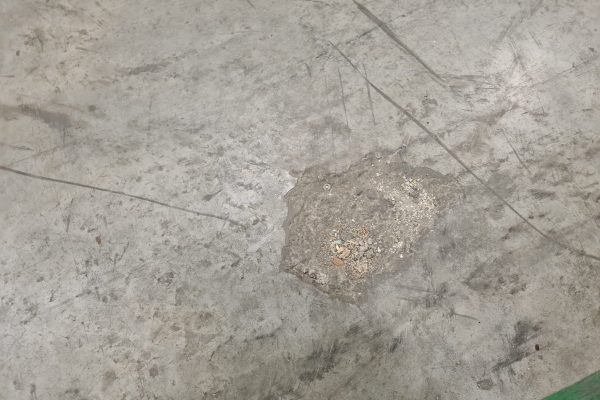
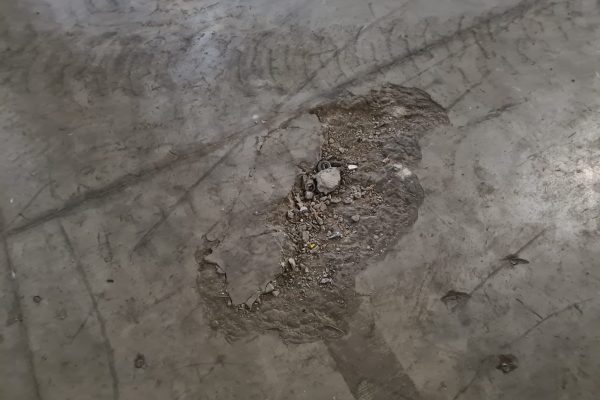
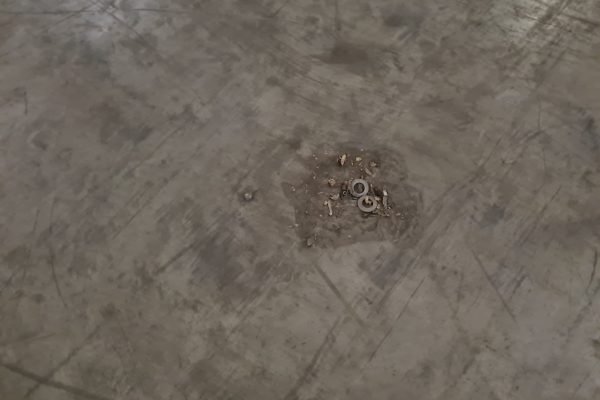
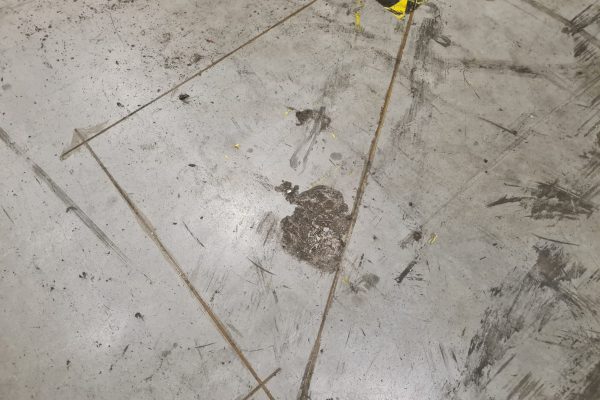
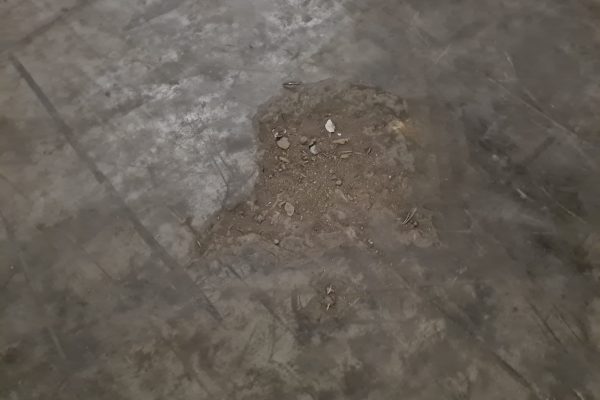
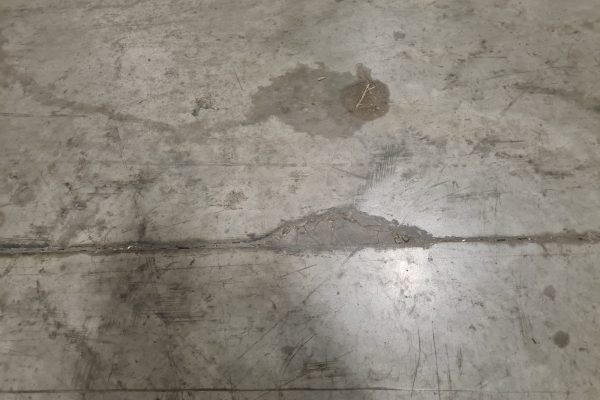
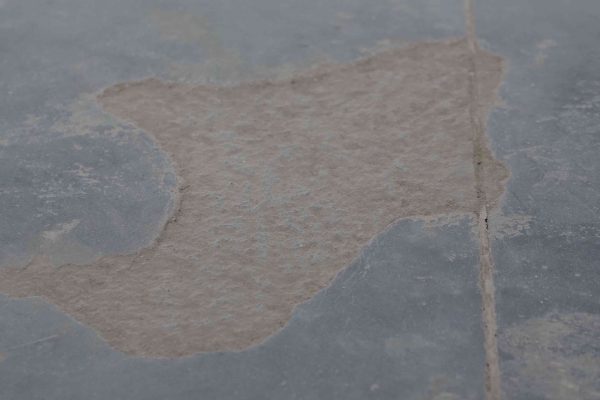
Minor patch (≤10×10 cm) with different shapes, round or squared. Patches can result from impact of goods on the floor or in areas where large cracks intersect. It makes the traffic of people and machines more difficult grows into a larger patch if not repaired on time.

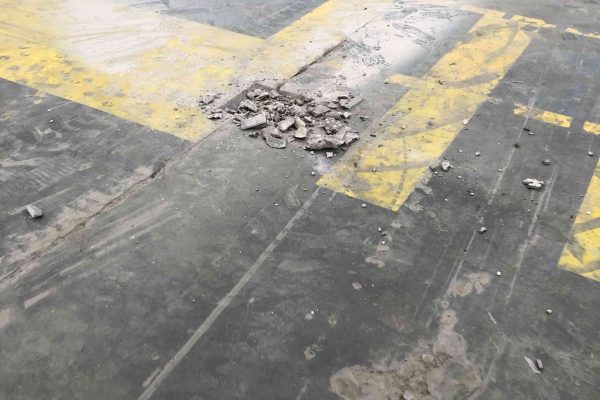
Medium sized patch (>10×10 cm) with different shapes, round or squared. These patches makes traffic of industrial vehicles almost impossible as the balance may be compromised if driving over these areas.

Large patch (>20×20 cm) that disallows to use a large area in a warehouse as it is impossible to drive through this area with industrial vehicles.

Very large patch (>50×50 cm) which obliges warehouse owners to close whole areas as the risk of an accident is more than probable.
We mark out the area to be repaired and any adjacent areas with hidden damage, and check whether the existing repair is loose, cracked, sunken or poorly bonded.
The perimeter is cut or milled so that the repair has clean, vertical edges to which it can adhere.
Loose materials, dust and contaminants are removed until a solid surface remains.
The area is filled with a non-shrink repair mortar selected according to the depth of the repair, the condition of the substrate, the loads and the traffic.
The depth and bond strength are checked before and after curing, and the flatness of the repaired area is verified.
The area is reopened once the mortar has set, and forklifts and other vehicles can drive over it again from 4 to 6 hours after the repair. Where the BECOSAN® treatment forms part of the project, the repair is integrated into it.
Not all damaged patches require the same course of action. The appropriate choice depends on the stability of the surrounding concrete and on whether the existing repair is still in good condition.
| Option | When it fits | Time on site and return to service | Maintenance | Limitation |
|---|---|---|---|---|
| Localised patch repair | The damage is limited and the substrate is stable | Depends on the number and size of patches; vehicle traffic from 4–6 hours after the repair | Periodic inspection of the repaired areas and of nearby joints and cracks | Not enough if cracks, hollow areas or failed patches extend beyond the visible damage |
| Wider repair of the zone | Cracks, hollow areas, failed patches or general deterioration are present | Longer; planned in phases so the rest of the building keeps operating | Periodic inspection of the whole zone, with fewer isolated repairs to track | Larger scope and more planning around operations |
| New mortar over the existing patch | Only if the old patch is sound and well bonded | Shorter on site, because the old patch is not removed | Close monitoring, as it can fail early if the bond is poor | If the old patch is loose, contaminated, cracked or poorly bonded, the fix is only temporary |
In summary, a localised repair is sufficient when the damage is limited and the substrate is in good condition. Where there are cracks, hollow areas or deteriorated patches, a more extensive repair is usually necessary.
Where the repair conditions require it, we use a Class R4 fast-setting mortar, bearing the CE mark in accordance with standard EN 1504-3. It achieves a bond strength to concrete of at least 2 MPa and a compressive strength of up to 50 MPa at 28 days, and has a reaction to fire classification of A1/A1fl in accordance with standard EN 13501-1.
As part of BECOSAN®’s quality control, the depth and bond strength of each repair are checked, both before and after curing. Repairs using concrete patches are covered by a 2-year written BECOSAN® warranty on workmanship, specific to this service, which covers the quality of the work carried out.
BECOSAN® UK Ltd operates in accordance with ISO 9001 and CHAS/SSIP standards

BECOSAN® has repaired concrete patches for large national and international companies. These four projects show the range of work.
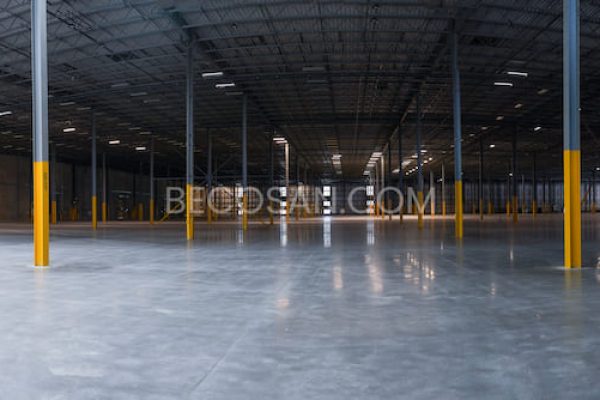
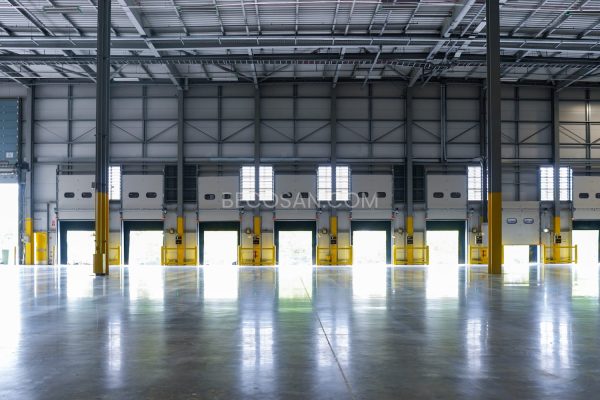
Floor area: 61,500 m²
Challenge: After more than 20 years of intensive industrial use, large sections of the warehouse floor had become severely worn and damaged. Localised areas of deteriorated concrete required structural patch repairs before the floor could be refurbished and handed over to the incoming tenant. Without these repairs, the surface would not have provided the durability or flatness required for logistics operations.
Solution delivered: Extensive concrete patch repairs were carried out in the most heavily damaged areas of the warehouse. Unsound concrete was removed, the affected sections were rebuilt using suitable repair materials, and each repair was levelled with the surrounding slab to create a continuous surface ready for the remaining refurbishment works and the application of the BECOSAN® treatment.
Result: The damaged areas were restored to a sound, durable condition, providing a uniform concrete surface capable of withstanding heavy warehouse traffic. The patch repairs formed a key part of the overall refurbishment, enabling the 61,500 m² facility to be successfully renovated and handed over to the new logistics operator within just 60 days.
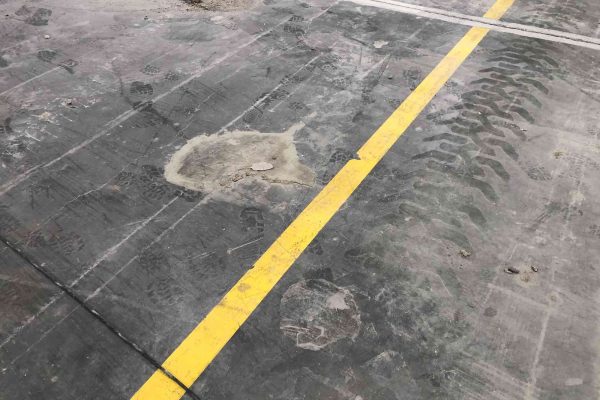
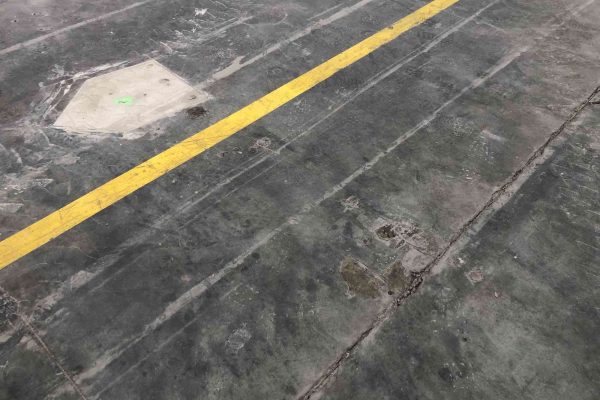
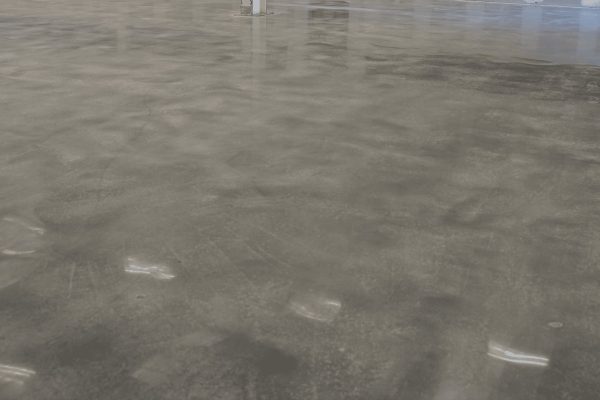
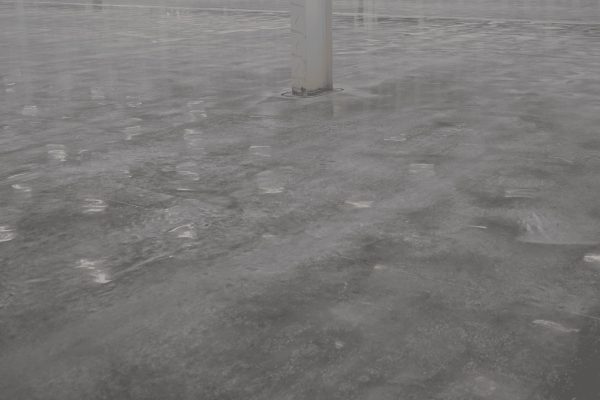
Floor area: 5,050 m²
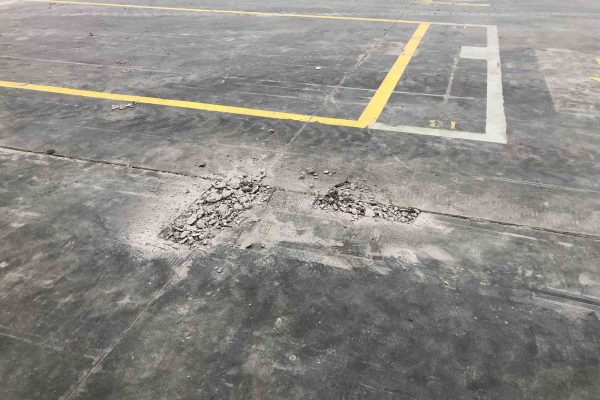
Challenge: During the refurbishment of an industrial warehouse, the concrete floor contained numerous damaged areas caused by previous operations and years of heavy use. Localised deterioration had resulted in both small and large surface defects that required structural concrete patch repairs before the floor could be prepared for the next stage of refurbishment.
Solution delivered: BECOSAN® completed a comprehensive concrete floor repair programme, carrying out 40 concrete patch repairs of varying sizes to restore damaged sections of the slab. Additional works included the removal of embedded anchors, repair and resealing of expansion joints and mechanical grinding to create a uniform, level surface across the 5,050 m² warehouse floor.
Result: The damaged concrete was successfully reinstated with durable patch repairs that restored the integrity and functionality of the existing slab. The warehouse floor was left level, structurally sound and fully prepared for the next phase of the refurbishment programme, extending the service life of the existing concrete without requiring slab replacement.
The cost depends mainly on the size and number of affected areas, the depth of the damage and the condition of the substrate. It also depends on whether the existing patch needs to be completely removed, the type of repair mortar required based on loads and traffic, and the access and working conditions on site, including working in sections, production stoppages or night-time work. Combining the repair with other work, such as crack repair, joint sealing, the removal of anchors or polishing, can also affect the scope of the work.
To provide a reliable quote, we need photographs of the damage, approximate dimensions, the location within the building, the type of traffic, the available working hours and any information regarding previous repairs.
Patch repairs are not always sufficient on their own. Applying new material over an unstable patch only provides a temporary solution, so any patch that is loose, contaminated, cracked or poorly bonded must first be removed. Cracks associated with the patch must also be repaired before the patch is rebuilt.
Some damage points to an underlying cause. If it is related to structural problems, damp, poor compaction or deep-seated deterioration of the slab, BECOSAN® will inform the client of this before defining the final scope of the repair. The same applies to any hidden damage detected beneath a previous repair: this is reported to the client before agreeing on the final solution.
Failed patches are usually due to a combination of several factors: poor workmanship in a previous repair, improper use of the structure, insufficient or incorrectly positioned expansion joints, impacts, and the spread of damage to adjacent areas.
It depends on the size and depth of the patches, the number of repairs required, and the mortar used. Following the repair, vehicle traffic can resume within 4 to 6 hours. BECOSAN® adapts to the client’s production schedule and works in sections where necessary.
In many cases, yes. The work is planned in sections, taking into account access points, working hours and the mortar’s setting time, to minimise the impact on internal traffic and loading operations.
The affected material is removed until sound concrete is exposed, the substrate is cleaned, and the area is filled with non-shrink repair mortar. The depth and bond strength are checked before and after curing.
Not always. If the old patch is loose, contaminated, cracked or poorly bonded, the new material applied on top may fail prematurely; therefore, the patch is usually removed and the area rebuilt on a stable base.
It depends on the size and number of patches, the depth, the condition of the substrate, the mortar, access and working conditions. To provide a reliable quote, we need photographs, approximate dimensions and, in some cases, a site visit.
Yes. Repairs come with a 2-year written guarantee from BECOSAN® covering the labour, specific to this service. This covers the quality of the workmanship.
Class R4 fast-setting mortars with CE marking in accordance with standard EN 1504-3, reinforced with corrosion-resistant metal fibres, for repairs between 10 and 300 mm deep.
Whether your floor has isolated holes or several deteriorating repairs, our specialists can assess the affected areas and recommend a suitable patch repair method. Send BECOSAN® UK Ltd photos, your site location and the approximate number and size of the damaged areas. Let us know what traffic the floor carries and when the areas can be made available for work, so we can discuss repair options and arrange a site inspection where needed to prepare a quotation.
Patch repair is often combined with other works on the same floor. If the damage is linked to a joint or a crack, see expansion joint repair and sealing and concrete floor cracks repair; if anchors or fixings are in the way, see screws and anchors removal. Other related services are concrete scratch repair, epoxy resin floor repair, warehouse floor refurbishment and the BECOSAN® treatment.