
BECOSAN® UK Ltd removes racking anchors, machinery bolts and screws from warehouse and factory concrete floors across the UK, and makes good the holes. Each fixing is lowered below the surface or extracted by core drilling, and the hole is filled with BECOSAN® J+C epoxy repair kit. The floor is left level, with no protruding fixings.
| Methods | Lowering below the surface or extraction by core drilling |
|---|---|
| Hole repair | BECOSAN® J+C epoxy filler (interior use only) |
| Output | Several hundred anchors per day |
| Project range | From a few hundred to more than 10,000 anchors |
| Warranty | 2 years, written |
| Certification | ISO 9001; SSIP accredited through CHAS |
| Coverage | United Kingdom |
1-minute explainer
When a warehouse changes tenants or its layout is altered, the racking is removed, but hundreds of screws and anchors may remain in the floor. These obstruct forklift traffic, hinder the re-configuration of the racking and pose a risk to day-to-day operations, so they cannot simply be left where they are.
BECOSAN® first assesses the type of anchor and its position in the floor, as not all anchors can be treated in the same way. Where the anchor and the floor allow, we completely remove the metal element by drilling and repair the hole to restore a continuous, robust surface. Otherwise, the anchor is ground down below floor level. Where the work forms part of a complete floor refurbishment, the anchors are removed prior to polishing and the BECOSAN® treatment, so that the repaired areas are integrated into the overall floor finish.
The racking is gone, but part of it is still here. Stay with me and I'll explain how we solve it.
When a warehouse changes tenant or its layout is modified, hundreds of screws and anchors can be left behind across the floor, and leaving them there is not an option. Besides preventing a completely obstacle-free surface, they can interfere with forklift traffic, make a new racking layout more difficult, and become a risk to daily operations.
So, how do we remove them? At BECOSAN®, we first assess the type of anchor and its position in the floor, because not every anchor can be treated in the same way. Depending on the situation, we can work on the anchor to leave it below floor level or remove it completely by drilling. When complete removal is required, we extract the metal element and repair the resulting hole to restore a continuous, resistant surface ready to go back into service.
And when this work forms part of a complete floor rehabilitation, we remove the anchors before polishing and applying the BECOSAN® treatment, integrating the repaired areas into the overall finish of the floor.
The goal isn't simply to remove a screw. It's to leave the previous layout behind and prepare the floor for whatever comes next. If you're preparing a warehouse for a new tenant, a new layout, or a change in machinery, contact the BECOSAN® technical team.
1-minute explainer
Anchors are usually removed when there is a change of tenant or at the end of a tenancy agreement, during the refurbishment of a warehouse or when its use changes, when replacing shelving or machinery, and to ensure the safety of staff walkways.
| What you see | Usual cause | What BECOSAN® does |
|---|---|---|
| Bolt heads or studs sticking out of the floor | Racking, machinery or guards removed without removing their fixings | Lowers each fixing below the surface or extracts it by core drilling, then makes good the hole |
| Forklift or pallet-truck wheels catching on fixings | Exposed anchors in traffic routes | Removes or lowers every exposed anchor along the route and fills the holes level with the floor |
| Dozens or hundreds of bolt heads visible after a racking change | Fixings from the previous layout left in the slab | Clears the area zone by zone; the filler can be pigmented to reduce contrast with the slab |
| Open holes, loose edges or hollow areas around old fixings | Concrete weakened around the fixing, or a fixing removed without a proper repair | Checks the concrete around the fixing, cleans and fills the hole, and carries out local concrete patch repair where the damage is wider |
| Floor must be handed back free of fixings | Lease requires the floor in its original condition | Programmes the removal by zones to meet the handover date |
| Rusted or deteriorated anchors | Corrosion over time | Full extraction by core drilling |
Fastenings we remove: shelving anchors, machinery bolts, fixing bolts, expansion anchors, threaded rods and studs, screws, and fastenings for barriers, guards and stops. Each type of fastening is assessed individually to decide whether it should be recessed, extracted or treated as part of a localised repair.
Fixings left behind after machinery has been removed from a factory
BECOSAN® UK Ltd removes the fixings left in a factory floor once the machinery has been removed: fixing bolts, threaded rods, studs, expansion anchors and fixings for guards and barriers. Each of these is either ground down below the surface or extracted using a core drill, and the hole is repaired using the BECOSAN® J+C repair kit.
This work is usually required prior to a new production layout, the handover of a leased premises or a complete floor refurbishment. We begin with an assessment of the fixings and the surrounding concrete, and can plan the work in zones so that production can continue where necessary.
To assess the work, we require photographs of the floor, the location of the site, the approximate area and the estimated number of fixings.
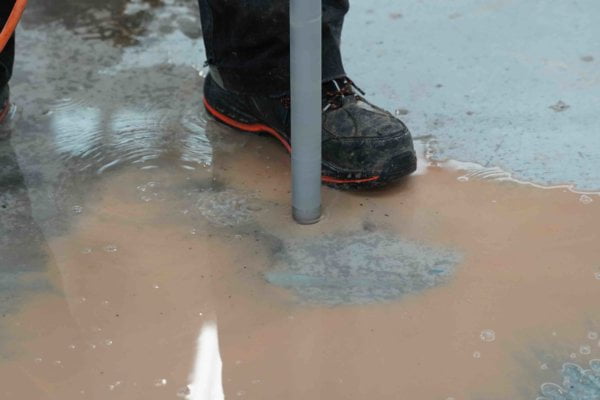
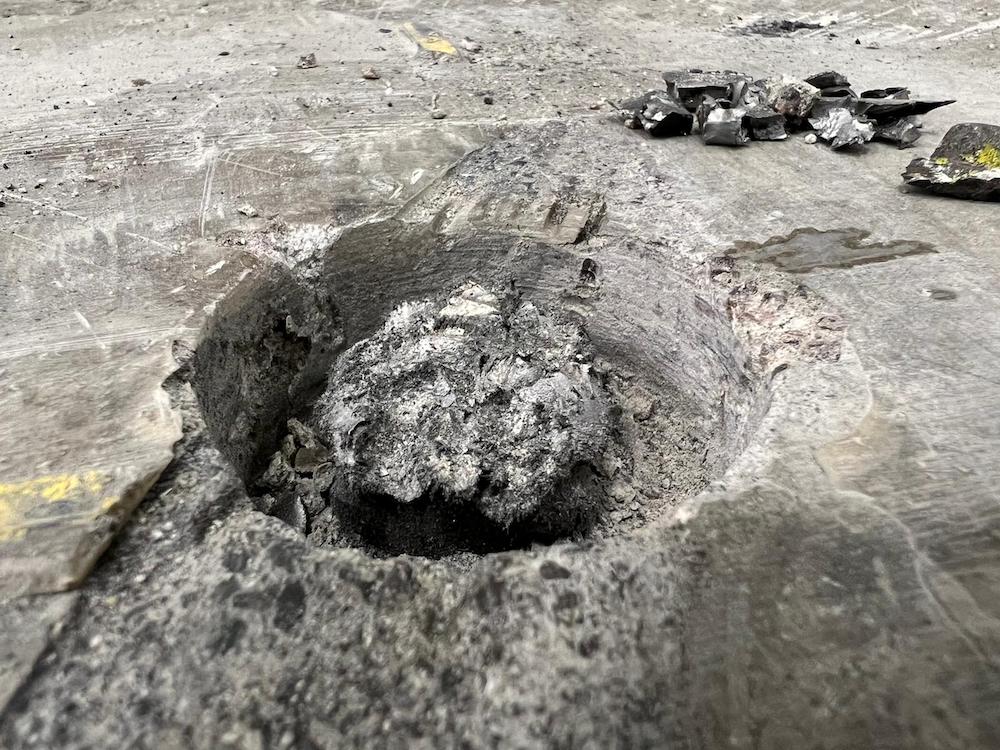
We check the type, depth and diameter of each fixing, the condition of the concrete around it (cracks, chipped edges, hollow areas), the number of anchors, and the future use and traffic on the floor.
Each anchor is either sunk below the surface or removed completely.
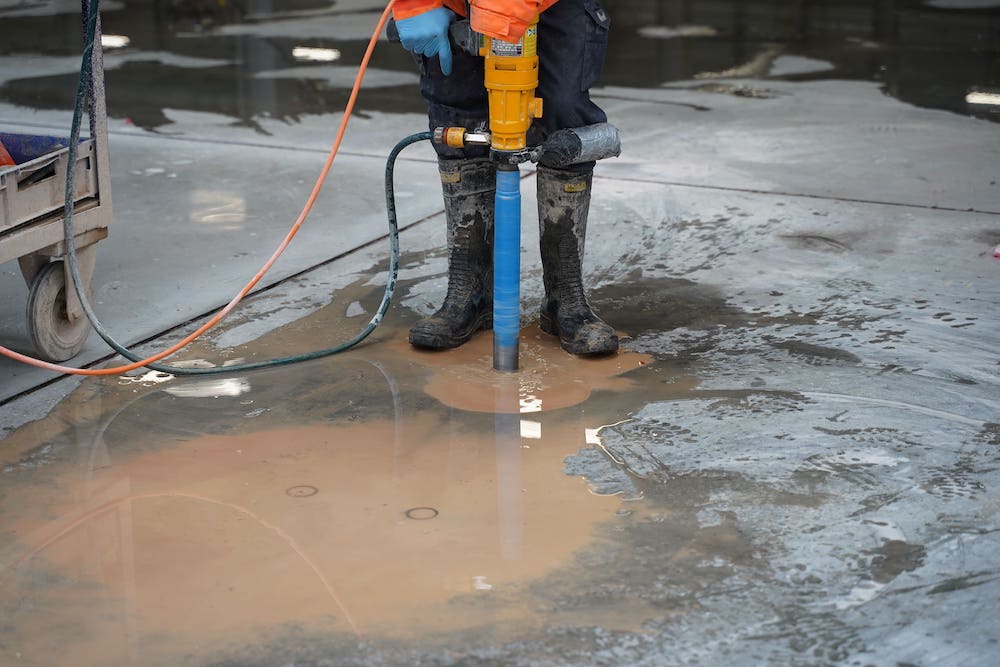
To sink an anchor, we drill a hole next to it so that it can be sunk into the floor. To remove it, we drill a hole using a core bit around the fixing and remove the metal element.
Loose materials and dust are removed so that the filler adheres to the sound concrete.
The epoxy filler seals the hole and stabilises the treated area to withstand the anticipated traffic. It can be pigmented to reduce the contrast with the slab.
If the removal is part of a refurbishment, the next steps involve repairing joints and cracks, removing road markings, polishing and treating the surface with BECOSAN®, which hardens and seals the surface.
BECOSAN® selects the method for each fixing after assessing the anchor and the surrounding concrete. Where the anchor and the substrate allow, we prefer to remove the fixing completely using a core drill, so that no metal remains in the slab. Where complete removal is not suitable – for example, because it could compromise the surrounding concrete – we lower the anchor below the surface. In both cases, the hole is filled using the BECOSAN® J+C repair kit.
| Aspect | Full extraction by core drilling | Lowering below the surface |
|---|---|---|
| Our approach | Preferred where the anchor and the floor allow it | Used where extraction is not suitable |
| How it works | The concrete is core-drilled around the fixing and the metal is removed | A hole is drilled next to the anchor so it can be sunk into the floor |
| Metal left in the slab | No | Yes, below the surface |
| Hole repair | BECOSAN® J+C Repair Kit | BECOSAN® J+C Repair Kit |
| Maintenance | Periodic inspection of the filled holes | Periodic inspection of the filled holes |
| When it fits | The anchor and the surrounding concrete allow it. It is the method used when the fixing interferes with a new installation, is deteriorated or corroded, or the project requires removing the whole element | The anchor is in sound condition and does not interfere with a new installation, or extracting it could damage the surrounding concrete |
Wherever the project allows, BECOSAN® recommends complete removal, as this removes the metal from the slab and prevents corrosion or any interference with future installations. Recessing remains an option when the anchor is in good condition and does not pose any obstacle.

Regulations (England, Wales and Scotland). Regulation 12 of the Workplace (Health, Safety and Welfare) Regulations 1992 requires that floors in workplaces must not have any holes or uneven surfaces that expose people to risks and that, as far as is reasonably practicable, they must be kept free from obstacles that could cause a person to slip, trip or fall. Removing protruding fixings and filling in holes helps the person responsible for the premises to comply with this obligation. Regulation 12 on legislation.gov.uk. Northern Ireland has its own regulations.
Quality and safety. BECOSAN® UK Ltd is ISO 9001 certified and SSIP-accredited through CHAS. Check this on the SSIP Portal
Guarantee. The removal of anchors and the repair of holes are covered by a 2-year written guarantee from BECOSAN® on the workmanship, specific to this service.
Repair material. BECOSAN® J+C repair kit, for indoor use.

All those that are attached to the floor, such as:
There are several circumstances in which a property owner, asset manager or facilities manager requires the removal of embedded anchors and screws from an industrial floor:
We have worked with large national and international companies.


The cost depends mainly on the number of anchors, the type of fixing, the method (lowering or complete extraction), the condition of the concrete around the fixings, and any subsequent repairs, polishing or floor treatment that may be required. Access, working in sections, working outside normal hours and combining the work with other repairs can also affect the scope of the work.
To provide a reliable quote, we need photographs, the location of the site, the approximate surface area and the estimated number of fixings.
BECOSAN® UK Ltd removes anchors and bolts from racking on concrete warehouse floors throughout the UK and repairs the holes using its J+C epoxy repair kit. Each fixing is either countersunk below the surface or removed using a core drill, and the work can be combined with the repair of joints, cracks and patches, as well as floor treatment.
Companies specialising in concrete floor repair, such as BECOSAN® UK Ltd, remove the fixing bolts, threaded rods, studs and expansion anchors left behind after machinery has been removed, and repair the holes. When comparing companies, ask whether the repair of the holes and the handover of the floor are included.
Generally, a team can remove and seal several hundred anchors a day. The timetable depends on the number and type of anchors, their depth and the condition of the concrete. On large-scale projects, we work in zones and draw up a timetable following an on-site assessment.
Ye. Where necessary, we carry out the work without disrupting plant operations. The work is organised by zones, using dust extraction systems and, if necessary, outside normal production hours. Feasibility depends on the number of anchors, access, internal traffic and the plant’s safety regulations.
The cost depends mainly on the number of anchors, the type of fixing, the method used, the condition of the concrete and any subsequent repairs required. To provide a quote for the work, we usually need photographs, the site location, the approximate surface area and the estimated number of fixings.
Not always. On many industrial floors, it is sufficient to drive the anchor below the surface and repair the hole. Complete removal is recommended when the anchor interferes with a new installation, is damaged or corroded, or when the project requires the element to be removed entirely.
The BECOSAN® J+C repair kit, a two-component, solvent-free, low-viscosity epoxy filler with some flexibility and a cycloaliphatic hardener. It can be pigmented and is recommended for indoor use only.
Yes. The removal of anchors and the repair of holes are covered by a 2-year written guarantee from BECOSAN® on the labour.
BECOSAN® removes redundant racking and machinery fixings and repairs the affected areas of your concrete floor. Send us photos, the approximate number of fixings and your site location, together with any handover deadlines or access restrictions. If available, include the fixing types and dimensions. Our specialists will review the details, discuss the appropriate removal and repair method, and arrange a site inspection where needed to prepare a quotation.