
Epoxy resin is a material that is increasingly used as a flooring solution, particularly in industrial and commercial environments. However, there is still considerable confusion between what epoxy paint is and what actually constitutes an epoxy coating.
With similar labelling and almost identical names, people often assume that both serve the same purpose.
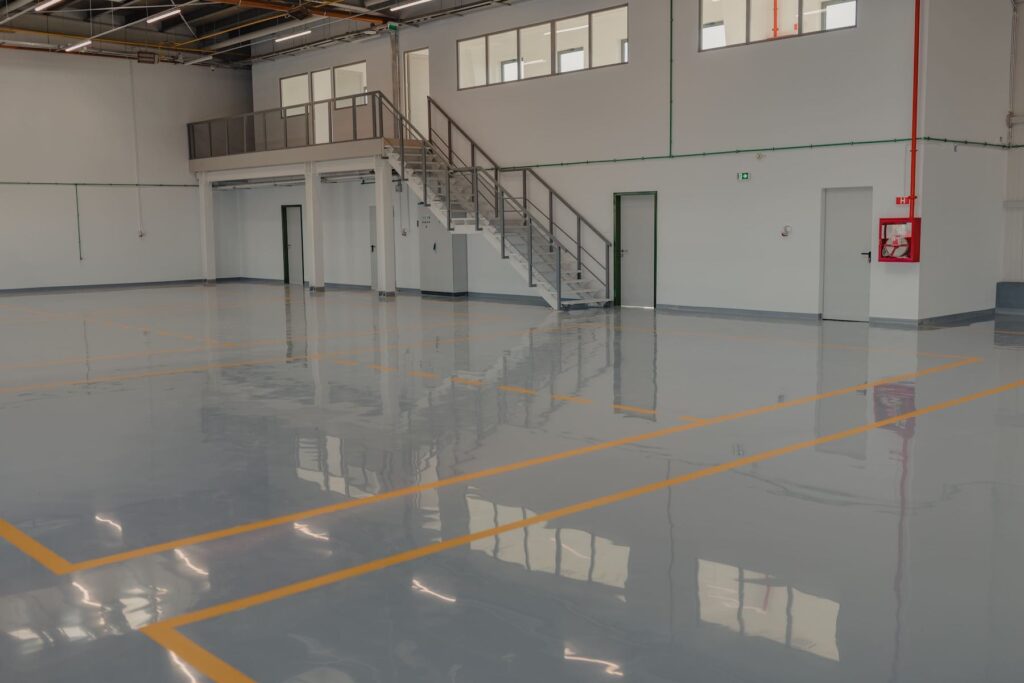
In this article, we explain what an epoxy coating is, what happens when it is applied and, above all, how it differs from epoxy paint.
What is an epoxy resin coating?
Epoxy coatings are systems based on resins which, when mixed with a hardener, undergo a chemical reaction that forms a solid layer bonded to the substrate.
When applied to a floor, they create a continuous surface that can be smooth, self-levelling or finished in different ways, depending on the system used. Although in its base state it may be transparent, it is usually pigmented or combined with mineral fillers to suit the needs of the project.
Unlike epoxy paint, a coating does not simply provide colour or superficial protection, but creates a layer with greater thickness and performance over the existing floor.
It can be applied to existing floors, provided that the substrate has been properly prepared.
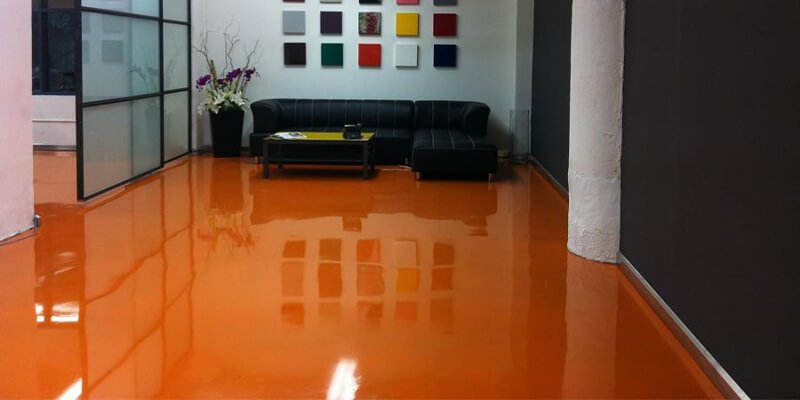
What happens when an epoxy resin coating is used?
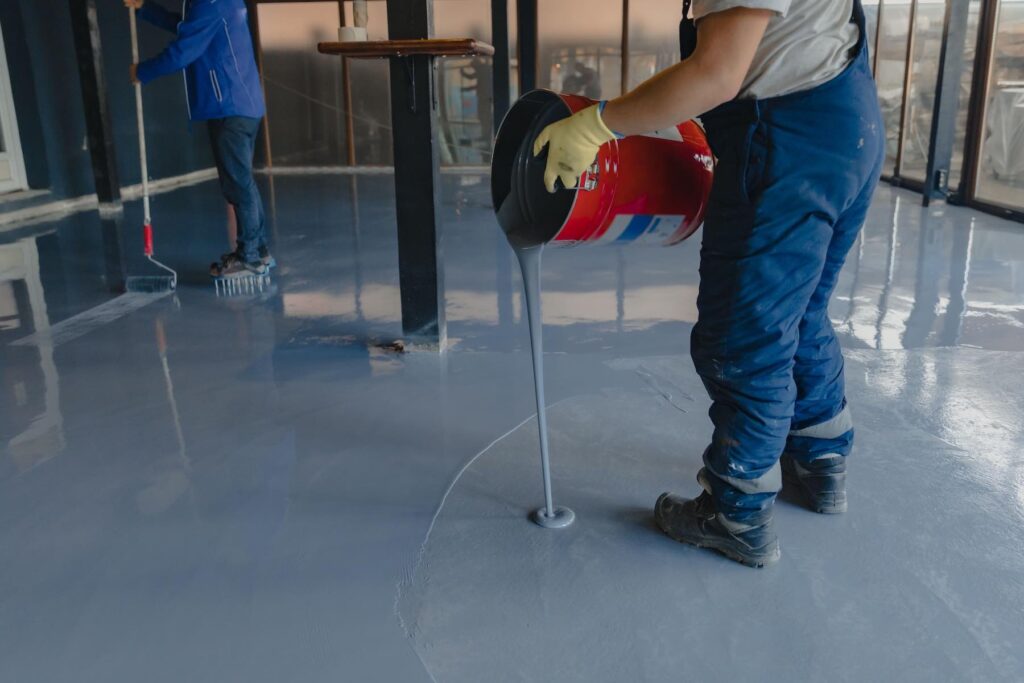
An epoxy coating creates a continuous layer over the floor, acting as a wearing surface and modifying its behaviour in terms of wear, traffic and daily use.
Its application requires prior preparation of the substrate, including cleaning, repairing defects and, in many cases, levelling the floor.
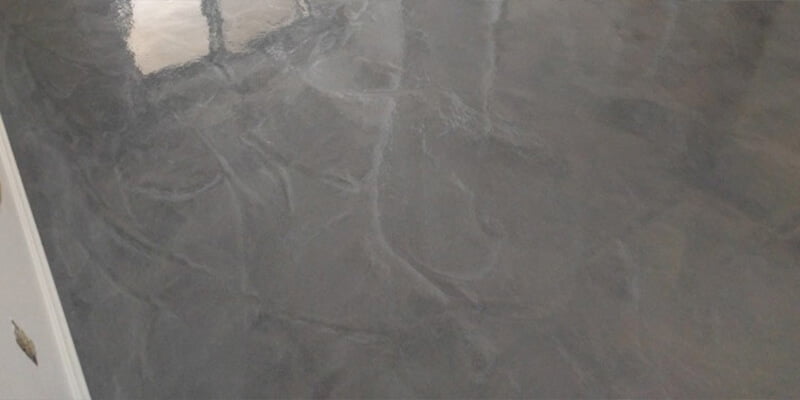
The thickness of the system depends on the type of coating used and is greater than that of epoxy paint. This increased thickness improves surface resistance and the overall continuity of the floor.
In some systems, particularly those with a high solids content, the application time is limited, which requires controlled and professional execution.
As for curing, times may vary depending on the product and environmental conditions, so it is always important to follow the manufacturer’s instructions. As a general guideline, it may be necessary to wait at least two days before walking on the surface and up to seven days before placing furniture or equipment on it.
Advantages of an epoxy coating
Epoxy coating is a widely used solution in certain environments due to its performance.
Among its main advantages are its ability to create continuous surfaces, its good mechanical resistance and its behaviour against common chemicals found in industrial environments. It also makes cleaning and maintenance of the floor easier.
From an aesthetic point of view, it allows for uniform and customisable finishes, with different levels of gloss or texture depending on the needs of the project.
Due to its characteristics, it is commonly used in car parks, warehouses, hospitals, laboratories and other spaces where a resistant and easy-to-maintain surface is required.
However, these advantages must always be assessed according to the intended use, the condition of the substrate and the correct execution of the system.
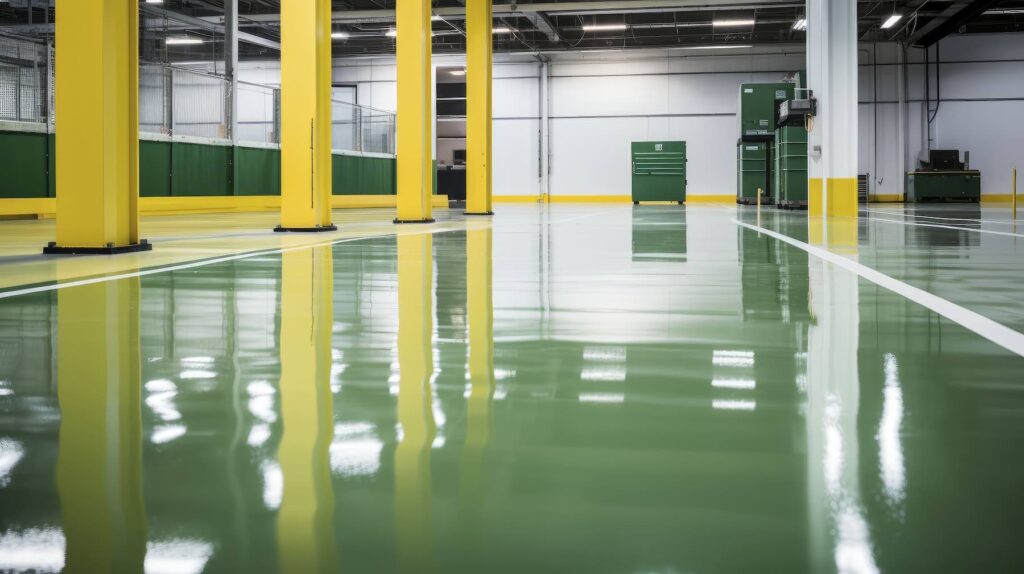
When is it appropriate to use an epoxy coating? And when epoxy paint?
For simpler projects or those with lower requirements, such as domestic applications or areas with light traffic, epoxy paint can be a suitable solution, as it improves the appearance of the floor with a relatively simple application.
However, when higher performance is required, such as in industrial, commercial or logistics environments, epoxy coating is usually more appropriate. In these cases, the floor is subject to more intensive use, with frequent traffic, regular cleaning or exposure to chemical agents.
In such situations, epoxy paint often falls short in terms of durability, whereas a properly applied coating can provide better long-term performance.
Difference between epoxy resin coatings and epoxy paints
The main difference between both systems lies in their thickness, function and performance.
The thickness of epoxy paint is usually low, typically in the range of 100 to 300 microns (0.1 – 0.3 mm), even when several coats are applied. For this reason, it mainly acts as a surface finish with limited resistance to intensive use and does not allow for correcting irregularities or levelling the floor.
In contrast, epoxy coatings are applied at greater thickness, usually between 1 and 3 mm in self-levelling systems, and can reach higher thicknesses in multi-layer systems or epoxy mortars. This greater body improves the resistance of the floor and, in some cases, allows minor imperfections in the substrate to be corrected.
Another important difference is the complexity of application. While epoxy paint can be applied in simple projects, epoxy coatings usually require more technical and controlled execution.
Another factor that differentiates epoxy coating from epoxy paint is the price, as the former is significantly more expensive than the latter, often costing four or five times more.
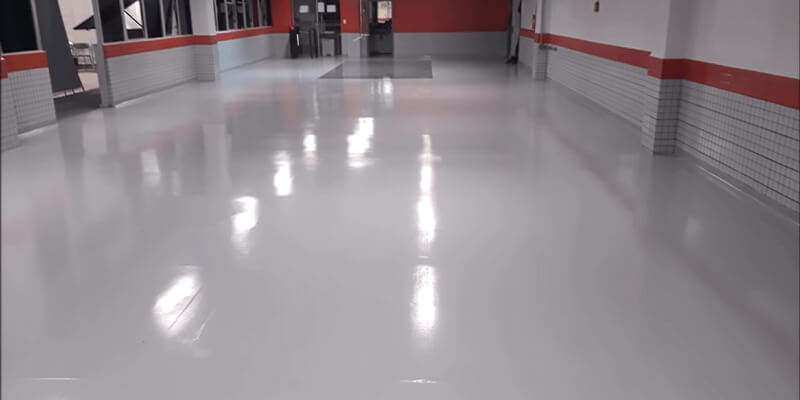
However, where most confusion arises is in the terminology used.
Many consumers or DIY users refer to all products as “paint”, overlooking the fact that they may actually be coatings. As a result, manufacturers often label all products as paints.
This has created significant confusion, as what is sold as epoxy paint may in fact be either a coating or a paint. This has led many people to choose the wrong product, so it is always advisable to check the technical specifications rather than relying solely on the commercial name
Conclusions
Epoxy coating and epoxy paint are not the same, although they are often confused.
The former is intended for more demanding applications where greater durability, resistance and continuity of the floor are required. Epoxy paint, on the other hand, can be a valid solution for less intensive uses or as a surface improvement.
The choice between one system and the other should be based on the actual use of the floor, the condition of the substrate and the required performance, not only on price or initial appearance.
The application of an epoxy coating must be carried out by a professional team, as, unlike epoxy paint, it requires controlled technical execution. Epoxy resin can also present risks during application, making it essential to follow the process accurately, as poor application may lead to various problems with epoxy resin in the finished floor.
In any case, before opting for a resin-based solution, it is advisable to also consider other alternatives available for industrial flooring, such as concrete polish solutions, especially when long-term durability, low maintenance and reduced costs are required.