
In theory, an epoxy floor should give an industrial building a tough, attractive and easy-to-clean surface. In practice, many UK warehouses and factories end up with the exact opposite: peeling coatings, hollow sounding patches and dangerous trip hazards only a few years after installation.
In most cases, the root cause is simple and uncomfortable: inadequate surface preparation of the concrete slab.
Instead of bonding into the concrete, the resin only grips a weak surface layer or a contaminated film. Once traffic, forklifts and thermal changes start to work, the coating comes off in sheets long before the end of its “design life”.
How epoxy is supposed to bond to concrete
For an epoxy coating to perform properly, three basic conditions must be met:
- Correct mechanical preparation
- The concrete must be ground, shot-blasted or milled to remove the laitance and open the pores.
- The profile should typically be similar to a CSP 2–3 (or higher, depending on the system).
- The goal is to create a clean, rough, high-energy surface the resin can bite into.
- Clean, dry, uncontaminated concrete
- Dust must be fully vacuumed, not just swept.
- Oils, tyre marks, curing agents, acrylic sealers or old hydrophobic treatments must be removed.
- Moisture levels must be within the range specified by the manufacturer.
- A correctly designed and applied epoxy system
- Primers and body coats must be compatible with the substrate and with each other.
- Mixing ratios, pot life and temperature/humidity limits must be respected.
- Viscosity must allow the product to wet out the surface and penetrate the open pores.
If any of these elements are missing, adhesion is never truly achieved. The coating sits on the concrete rather than becoming part of it.
What inadequate surface preparation looks like on site
You can often spot poor preparation without laboratory tests. Typical symptoms include:
- Blisters and bubbles that appear weeks or months after installation, often linked to moisture or trapped contaminants.
- Sheets of coating peeling away, leaving clean, almost bare concrete underneath a sign that the resin never really soaked into the slab.
- Hollow-sounding areas when lightly tapped with a hammer or scraper.
- Localised tearing in high-traffic zones, especially at turning points for forklifts, loading bays and picking lanes.
- Sharp edges and trip hazards, where fragments of the coating have broken loose.
By the time these signs are visible, the problem is rarely “just a small repair”. The interface between resin and concrete has failed, and the system is fundamentally compromised.
The most common preparation mistakes
On industrial projects across the UK, the same issues appear again and again.
1. Only cosmetic cleaning before coating
Skipping proper mechanical preparation is probably the number one cause of failure:
- The slab is simply swept or pressure washed.
- The laitance layer weak, smooth and powdery is left in place.
- The surface profile is far too smooth for a high-build coating.
Result: the epoxy bonds to a fragile skin instead of solid concrete. Once that skin starts to break up, the entire system delaminates.
2. Contaminants left in or on the slab
Even where grinding or shot-blasting has been performed, contamination can remain:
- Oils and greases deeply absorbed into the concrete.
- Tyre residues, plasticiser marks and warehouse dirt.
- Old sealers, curing compounds or hydrophobic treatments that repel the new resin.
- Loose dust that has not been thoroughly vacuumed.
These create isolated islands of poor adhesion. Over time, traffic and thermal movement convert those islands into larger and larger detached areas.
3. Moisture and vapour pressure ignored
Moisture is another silent enemy of epoxy floors:
- Coatings are applied on slabs that are still too young or too wet.
- There is no effective vapour barrier below the concrete.
- Rising damp and vapour pressure push against the underside of the coating.
Initially, the floor may look acceptable. But as vapour pressure builds, you see blisters, whitening and, finally, wholesale debonding.
4. Problems inside the coating system itself
Even with perfect preparation, the coating can fail if:
- Resin and hardener are not mixed in the correct ratio.
- The material is applied after its pot life has expired.
- Primers and body coats are not compatible.
- Temperatures are outside the recommended range, affecting cure and wetting.
Again, the end result is the same: a film that never properly keys into the concrete and is easily torn away by real-world use.
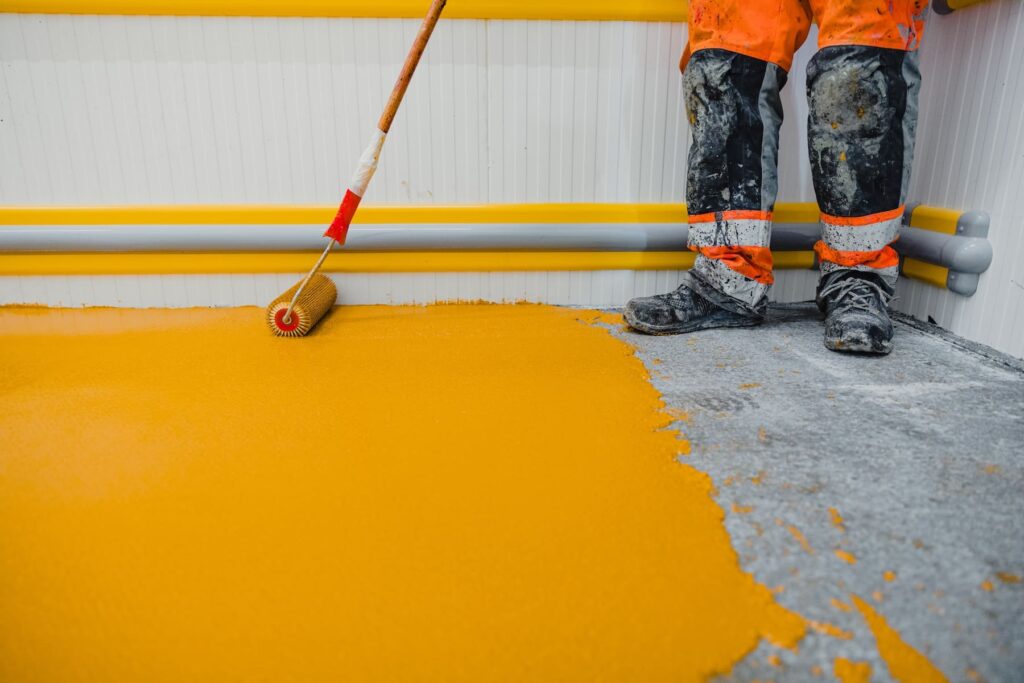
Can a poorly bonded epoxy floor be saved?
If adhesion problems are limited to a few isolated areas, localised repairs are sometimes possible:
- Remove all loose or hollow sounding coating.
- Prepare the exposed concrete mechanically to the right profile.
- Rebuild the system, respecting moisture limits and technical data sheets.
However, when debonding is widespread which is often the case in logistics warehouses and manufacturing plants patch repairs are usually short-lived. You end up chasing failures from one area to another, with repeated shutdowns and no long-term guarantee.
At that point, the technically honest solution is to:
- Remove the failing epoxy system completely, typically by heavy grinding or controlled milling.
- Assess the real condition of the slab, joints, cracks, flatness, porosity, moisture.
- Decide whether it still makes sense to install another film-forming resin… or whether it is time to change strategy.
Rethinking the floor: making concrete the finished surface
One way to eliminate the whole adhesion problem is simple: stop relying on a resin film as the working surface.
Instead, more and more owners are choosing systems that treat and densify the concrete itself a category often grouped within modern industrial flooring solutions turning the slab into the final industrial floor without any coating that can peel.
Densified and polished concrete floors:
- Increase the surface hardness and abrasion resistance of the slab.
- Reduce dusting and liquid absorption dramatically, making daily cleaning easier.
- Offer different visual finishes from low-sheen matt to high gloss without adding a separate layer that might detatch.
On new builds, the most robust strategy is often to:
- Design a good structural slab with appropriate reinforcement and joints.
- If required, add a properly installed dry-shake or quartz-topped wearing layer.
- Finish the floor with a professional grinding, densifying and polishing process, instead of applying a resin coating.
This way, the performance of the floor is driven by the quality of the concrete and the mechanical/chemical treatment, not by the fragile bond of a thin film.
Looking for an epoxy flooring alternative?
If your existing epoxy floor is already bubbling and peeling, or if you are planning a refurbishment and want to avoid the same problem happening again in a few years, it may be time to consider a different type of system altogether.
Rather than installing yet another coating that depends on perfect surface preparation and ideal site conditions, many facility owners are now looking for an epoxy flooring alternative that works directly with the concrete substrate.
Systems like BECOSAN® polished concrete transform the original slab into a hard, dust-free, easy-to-maintain industrial floor without a film that can de-bond, peel or flake under heavy use.
Conclusion
When an epoxy floor fails, it is tempting to blame the product. In reality, the weak point is almost always the interface between resin and concrete, and that interface is defined by surface preparation.
- If the slab is not opened, cleaned and dried correctly, adhesion is compromised from day one.
- If moisture and contamination are ignored, the coating will eventually lift.
- If site conditions and application procedures are rushed, the system will not reach its expected lifespan.
You can repair isolated defects, but once debonding is widespread, the most rational decision technically and economically is often to remove the failing coating and rethink the flooring concept.
For many UK warehouses, logistics platforms and production sites, that means moving away from traditional epoxy and choosing an alternative to epoxy resin flooring that uses the concrete slab itself as the final surface. The result: fewer surprises, less downtime and a floor that actually matches the demands of modern industrial operations.